



Worth Listening: How to Make a Mission-Driven Podcast
Next Chapter Podcasts & Voxtopica
What Getty Learned By Adding Video to a Museum Podcast
NOV 11, 202635 MIN
Description
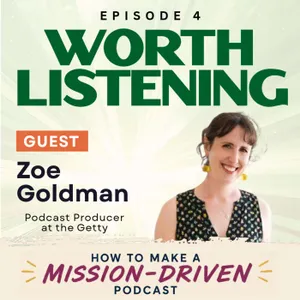
Getty piloted its meditation podcast as audio-only, and about half of listeners said they needed to see the art. Zoe Goldman, a podcast producer at Getty, explains why OMMM: Our Museum Mindfulness Meditation became Getty's first video podcast and what the camera cost her team. She also explains where Getty's podcast ideas come from and why she tells every organization to make a pilot first.
Zoe Goldman says any organization considering a podcast should make a pilot first, because a pilot shows how much work the show will take and whether the idea works at all. Getty has made five podcast series since 2016, and Goldman said she is currently the main person working on its shows.
They include Recording Artists, built from tapes and letters in the Getty Research Institute archives, and the family show If Objects Could Talk, now in its second season. Goldman studied art history and came to Getty in 2017, then took over production of Art + Ideas in 2018. She tells JT and Richard how she turns down podcast ideas without damaging relationships, and why the Getty Center's year-long closure, starting March 15, 2027, won't change the podcasts' strategy.
Key points
Goldman said the awards Recording Artists has won help her ask curators and archivists for their time, since podcast work comes on top of their regular jobs. She said all the archival material for a season is picked out before recording starts, because finding it and clearing the rights take so much work.
OMMM adapted gallery educator Lilit Sadoyan's weekly mindfulness tours at the Getty Center. About half the people who heard the audio-only pilot said they needed to see the art, so it became Getty's first video podcast. Goldman said its audience has split about evenly between audio apps and YouTube.
If Objects Could Talk went from her idea notes in 2020 to launch in 2025. Goldman said the pandemic and her team's workload slowed it, and the first season's 10 episodes took about a year to produce once Getty committed. Conservators review each episode at the outline stage and again at a late script draft, and Getty's communications department has final approval.
Goldman said video made OMMM slower and more expensive to produce. Getty rented a studio for it, and a cut that listeners would never hear in audio shows up on screen. She doubts video is worth the added cost for many projects.
Goldman said planning time should go into narrowing the audience. “The audience is not ‘everyone,’” she said, and a defined audience makes it easier to say no to ideas that don't fit.
About Zoe Goldman
Zoe Goldman is a podcast producer at Getty in Los Angeles. She joined Getty in 2017 and began producing Art + Ideas with then-president Jim Cuno in 2018. She produces Recording Artists and created If Objects Could Talk and OMMM: Our Museum Mindfulness Meditation.
Mentioned in this episode
Getty Podcasts
Recording Artists
If Objects Could Talk
OMMM: Our Museum Mindfulness Meditation
Art + Ideas
If this episode was informative, send it to someone at a mission-driven organization who is making or considering a podcast.
Follow Worth Listening wherever you get your podcasts.
Have a question about how to make a mission-driven podcast? Get in touch at www.MissionDrivenPodcasts.com or email us at [email protected]